
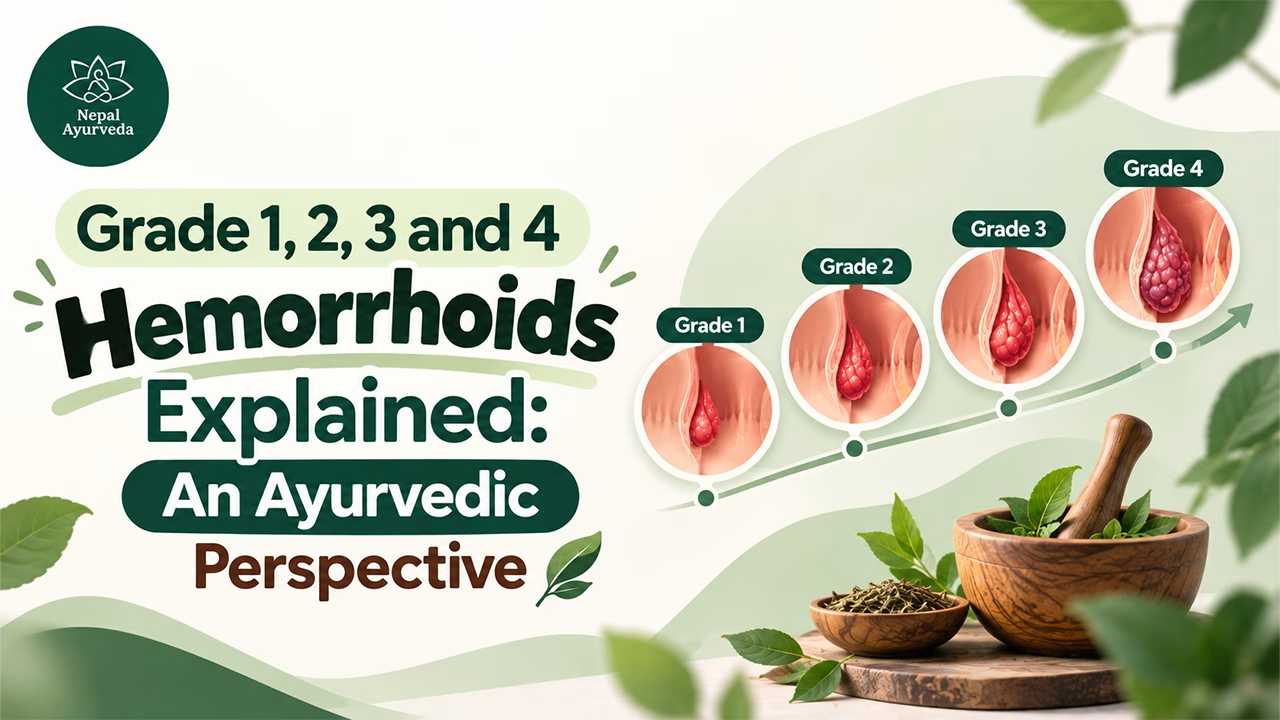
Hemorrhoids, commonly called piles, can range from mild internal swelling that stays inside the anal canal to permanently prolapsed tissue that cannot be pushed back in. Doctors commonly classify internal hemorrhoids into Grade 1, Grade 2, Grade 3 and Grade 4 according to the degree of prolapse. Grade 1 does not prolapse, Grade 2 comes out during straining but returns by itself, Grade 3 requires manual replacement, and Grade 4 remains prolapsed and cannot normally be pushed back inside.
Ayurveda approaches the condition from a different perspective. Hemorrhoidal disorders are traditionally discussed under Arsha (अर्श), but Ayurvedic assessment does not simply translate Grade 1, 2, 3 and 4 into four Ayurvedic categories. Instead, an Ayurvedic practitioner may also consider bowel habits, constipation, digestive function, diet, lifestyle, Dosha-related features and the individual patient before planning care. The Central Council for Research in Ayurvedic Sciences (CCRAS) similarly emphasizes individualized assessment before Ayurvedic medicines or procedures are selected.
Understanding both perspectives can be useful: the medical grade describes how far an internal hemorrhoid prolapses, while the Ayurvedic framework considers a wider pattern of symptoms and individual factors. Neither should be used for self-diagnosis when there is persistent rectal bleeding, significant pain or uncertainty about the cause.
What Are Hemorrhoids?
Hemorrhoids are enlarged or symptomatic hemorrhoidal tissues in and around the anus and lower rectum. Internal hemorrhoids arise inside the anal canal, while external hemorrhoids develop beneath the skin around the anus. Symptoms vary according to the type of hemorrhoid. Internal hemorrhoids may produce bright-red bleeding or prolapse, while external hemorrhoids may cause itching, swelling, tenderness or pain, particularly when a blood clot forms.
Common factors associated with hemorrhoids include straining during bowel movements, chronic constipation or diarrhea, spending prolonged periods on the toilet, a low-fiber diet, pregnancy, aging and frequent heavy lifting.
Importantly, rectal bleeding should not automatically be assumed to be piles. Inflammatory bowel disease, polyps, colorectal cancer and other digestive conditions can also cause bleeding. Persistent or unexplained bleeding therefore deserves professional evaluation.
For additional conventional medical information, see the NIDDK overview of hemorrhoids.
What Is Arsha in Ayurveda?
In Ayurvedic literature, conditions corresponding to piles are traditionally discussed under Arsha. CCRAS’s Evidence Based Ayurvedic Practice specifically discusses “Haemorrhoids (Arsha)” and describes classical Ayurvedic approaches alongside research-based interventions.
Ayurveda considers Arsha within a broader clinical picture rather than focusing exclusively on the visible pile mass. Traditional Ayurvedic interpretation may consider factors such as digestive function, bowel elimination, diet, lifestyle, Dosha involvement and the nature of symptoms.
Concepts such as Agni, referring broadly within Ayurvedic theory to digestive and metabolic function, and Apana Vata, traditionally associated with downward elimination, may form part of this assessment. Contemporary Ayurvedic literature also discusses Agnimandya, Dosha imbalance and altered bowel habits in relation to Arsha. These are traditional Ayurvedic explanatory concepts and should not be presented as established biomedical mechanisms of hemorrhoid formation.
This distinction matters. Modern hemorrhoid grading and Ayurvedic classification answer different questions; a person with Grade 2 hemorrhoids, for example, cannot automatically be assigned a particular Dosha category simply from the grade.
Grade 1, 2, 3 and 4 Hemorrhoids at a Glance
| Grade | What happens | Typical prolapse pattern | General clinical implication |
| Grade 1 | Internal hemorrhoid remains inside | No prolapse outside the anus | Conservative care is often considered first |
| Grade 2 | Hemorrhoid protrudes during straining | Returns inside by itself | Conservative care and, if needed, office-based treatment may be considered |
| Grade 3 | Hemorrhoid prolapses | Requires manual replacement | More detailed assessment is important; procedures may be considered |
| Grade 4 | Hemorrhoid remains outside | Cannot normally be manually reduced | Advanced prolapse requiring professional assessment |
This grading system applies primarily to internal hemorrhoidal prolapse. External hemorrhoids are assessed differently.
Grade 1 Hemorrhoids
Grade 1 internal hemorrhoids remain inside the anal canal and do not prolapse through the anus. A person may notice bright-red bleeding during or after bowel movements even though there is no visible tissue coming outside.
At this stage, bowel habits deserve particular attention. Modern colorectal guidelines identify dietary and behavioral modification as first-line treatment for symptomatic hemorrhoidal disease. Improving dietary fiber and fluid intake, reducing straining and avoiding unnecessarily long periods sitting on the toilet can be helpful.
Ayurvedic perspective on Grade 1 piles
An Ayurvedic assessment would not usually focus on “Grade 1” alone. The practitioner may also ask whether the patient experiences constipation, hard stools, irregular bowel movements, digestive discomfort, appetite changes or other associated symptoms.
Traditional management may therefore include Ahara dietary measures and Vihara lifestyle and routine alongside individualized Ayurvedic medicines when considered appropriate.
This does not mean every person with Grade 1 hemorrhoids requires herbal medicine. Nor should bleeding be treated at home indefinitely without confirming its cause.
Grade 2 Hemorrhoids
Grade 2 hemorrhoids prolapse through the anal opening during straining or defecation but return inside spontaneously once the straining stops.
Patients may notice bleeding, mucus, irritation or the temporary sensation of tissue protruding during bowel movements.
Conservative care remains important. If symptoms persist despite appropriate dietary and bowel-habit changes, the 2024 American Society of Colon and Rectal Surgeons guideline states that Grade I and II and selected Grade III internal hemorrhoids may be treated using office-based procedures. Rubber-band ligation is considered the most effective office-based option in that guideline.
Ayurvedic perspective on Grade 2 piles
Grade 2 disease is particularly relevant to discussions of Ayurvedic procedural therapies because some small clinical studies have evaluated Kshara application in first- and second-degree internal hemorrhoids.
For example, published Ayurvedic research has investigated Apamarga Kshara in Grade 1 and 2 internal hemorrhoids, including a small open-label randomized controlled trial comparing Kshara application with sclerotherapy and another small comparative study involving Kshara, infrared coagulation and an Ayurvedic oral intervention.
These studies are useful but limited. They do not establish that Kshara is superior to standard treatment generally, that every Grade 2 patient is suitable for Kshara, or that results are guaranteed.
Grade 3 Hemorrhoids
Grade 3 hemorrhoids prolapse outside the anus and do not return inside automatically. They can, however, usually be pushed back manually.
At this stage, prolapse is more significant and an examination becomes increasingly important. Symptoms, bleeding, associated external hemorrhoids, previous treatment and individual health factors all influence treatment choice.
Modern guidelines allow office-based treatment for selected Grade 3 hemorrhoids but also recognize that patients with significant Grade III disease, particularly combined internal and external disease, may require more invasive treatment.
Ayurvedic perspective on Grade 3 piles
CCRAS’s Ayurveda practice document discusses Kshara Sutra ligation for selected chronic second- and third-degree piles that have not responded to conservative medicines, specifically stating that this should be based on assessment by a qualified doctor.
Kshara Sutra is a practitioner-led para-surgical technique involving a specially prepared medicated thread used for ligation in selected cases. Published comparative research has investigated Kshara Sutra for hemorrhoids, but the available studies are relatively small and should not be interpreted as proof that it is appropriate for every Grade 3 hemorrhoid.
Nepal Ayurveda currently lists Kshara Sutra among its anorectal services, including use for selected hemorrhoids. Ayurveda Nepal
Learn more about Kshara Sutra Therapy at Nepal Ayurveda.
Grade 4 Hemorrhoids
Grade 4 is the most advanced prolapse category. The hemorrhoidal tissue remains outside the anus and cannot normally be pushed back inside manually.
Grade 4 hemorrhoids require professional examination. The presence of severe pain, extensive swelling, thrombosis, strangulation or significant bleeding can make evaluation more urgent.
The 2024 ASCRS guideline states that excisional hemorrhoidectomy is typically offered to selected patients with external hemorrhoids or symptomatic combined internal and external hemorrhoids in Grades III–IV.
Can Grade 4 piles be treated only with Ayurveda?
This question requires caution.
Ayurveda provides traditional approaches for Arsha, including medicines, Kshara-based procedures and surgical concepts. However, Grade 4 hemorrhoids should not be promised a non-surgical cure simply because Ayurvedic care is available.
An Ayurvedic practitioner with appropriate anorectal or Shalya expertise should examine the patient and determine whether an Ayurvedic intervention is suitable or whether referral for another medical or surgical approach is safer.
The goal should be appropriate treatment not avoiding conventional surgery at all costs.
How Ayurveda Looks at Piles Beyond Their Grade
The four grades tell us something very useful: how an internal hemorrhoid prolapses. But they do not describe every aspect of the patient’s condition.
An Ayurvedic consultation may additionally consider bowel regularity, stool consistency, straining, appetite, digestive complaints, dietary patterns, daily routine, physical activity and the characteristics of symptoms.
Ayurvedic theory may also consider Prakriti, or constitutional pattern, and the current state of Dosha imbalance. These concepts are used to individualize traditional care, not to replace physical examination or the medical hemorrhoid grade.
CCRAS itself emphasizes that Ayurvedic diet, lifestyle, medicines and therapies should be individualized and that severity and stage should be evaluated before treatment is planned.
This creates an important practical principle:
The hemorrhoid grade describes the prolapse. The Ayurvedic assessment considers the person as well as the disease.
What May Contribute to Arsha From an Ayurvedic Perspective?
Classical and contemporary Ayurvedic discussions of Arsha place considerable attention on bowel elimination, dietary patterns, lifestyle and digestive function.
From a traditional Ayurvedic viewpoint, irregular elimination and disturbance of Apana Vata may be considered relevant. Ayurvedic assessment can also examine Agni and Dosha-related patterns.
Interestingly, this traditional emphasis on bowel behavior overlaps at a practical level with modern hemorrhoid guidance—not because the underlying theoretical explanations are identical, but because conventional evidence also associates hemorrhoidal symptoms with constipation, excessive straining and prolonged toilet sitting.
For patients, this means improving bowel habits is not a minor part of care. It can be a central component of both symptom management and prevention strategies.
Ayurvedic Approach to Managing Piles
Classical Ayurvedic management of Arsha is broader than taking a single herbal product. CCRAS’s summary of Ayurvedic practice refers to four traditional categories associated with the management of Arsha: Bheshaja, Kshara, Agni and Shastra.
Ahara: diet and bowel support
Dietary advice should aim to promote comfortable, regular bowel movements rather than follow a rigid “piles diet” for every patient.
Modern evidence supports adequate fiber and fluids as part of first-line hemorrhoid care. Ayurveda can add individualized dietary considerations based on digestion, bowel pattern and constitution, but restrictive diets should not be prescribed automatically.
Vihara: lifestyle and toilet habits
Avoiding excessive straining and long periods sitting on the toilet is particularly important. Regular physical activity and establishing a comfortable bowel routine may also form part of an individualized plan.
Ayurvedic medicines
Ayurvedic medicines may be used by qualified practitioners according to symptoms and individual assessment. CCRAS publications describe several formulations investigated in its research program for Arsha. However, this does not mean those preparations or their published doses should be copied as self-treatment instructions. CCRAS itself states that prescription and duration should be determined according to clinical findings, tolerance and the individual patient.
Herbal and Ayurvedic products can also interact with medicines or be inappropriate in particular health conditions. Patients should therefore tell their practitioner about prescription medicines, supplements and other products they use.
Kshara Karma
Kshara Karma involves controlled clinical use of an alkaline Ayurvedic preparation on selected tissue. It is a practitioner-led procedure rather than a home remedy.
Small clinical studies have investigated Kshara application in early-grade internal hemorrhoids and reported encouraging findings, but the scale of the evidence remains limited.
Kshara Sutra
Kshara Sutra is another Ayurvedic para-surgical technique that may be considered for selected hemorrhoids when ligation is clinically appropriate.
CCRAS discusses its use in selected second- and third-degree chronic piles after failure of conservative management, with assessment by a qualified doctor.
Procedures such as Kshara and Kshara Sutra should therefore be considered clinical interventions requiring diagnosis, patient selection and follow-up, not general natural remedies.
Does Every Patient With Piles Need a Procedure?
No.
Dietary and behavioral changes are recommended as first-line treatment for many symptomatic hemorrhoids. Grade 1 and Grade 2 hemorrhoids and some Grade 3 hemorrhoids may be managed without conventional surgery, although persistent cases may require office procedures.
The same principle should apply when Ayurveda is involved. Treatment should progress according to severity and response rather than automatically beginning with a procedure.
A useful approach is:
assessment → bowel and lifestyle management → individualized treatment → procedure when indicated → referral when another approach is safer or more appropriate.
How Are Hemorrhoids Diagnosed?
Diagnosis generally begins with medical history and physical examination. The practitioner may ask about bleeding, constipation, pain, prolapse, bowel habits, medicines, diet and previous treatment.
External hemorrhoids can often be identified on inspection. Evaluation of internal hemorrhoids may involve a digital rectal examination and anoscopy or other investigations when clinically indicated.
This step matters because anal bleeding, pain and swelling can occur with conditions other than hemorrhoids.
An Ayurvedic evaluation can add assessment of digestive and lifestyle patterns, but it should not substitute for appropriate anorectal examination when one is needed.
When Should You Seek Medical Attention?
Professional assessment is particularly important when there is persistent or recurrent rectal bleeding, worsening prolapse, a painful anal lump, symptoms that do not improve with basic measures or uncertainty about whether the problem is actually hemorrhoids.
Seek prompt medical care for severe anal pain with rectal bleeding, particularly when bleeding occurs with abdominal pain, diarrhea or fever.
Heavy bleeding, dizziness, fainting, weakness, shortness of breath, black or tarry stool or other signs of significant gastrointestinal bleeding also require urgent medical evaluation.
Ayurvedic treatment should never be used to delay assessment of potentially serious bleeding.
Ayurvedic Piles Treatment in Kathmandu, Nepal
For people looking for an Ayurvedic approach to piles in Kathmandu, the most useful first step is a proper assessment rather than selecting a therapy based only on an online description of Grade 1, 2, 3 or 4.
Nepal Ayurveda currently describes a piles-care pathway in Kathmandu that may include bowel-habit and dietary guidance, individualized Ayurvedic medicines, supportive care and Kshara-based procedures for selected patients. The service page also emphasizes that treatment depends on the type and severity of hemorrhoids rather than automatically using one procedure for everyone.
For service details, see Ayurvedic piles treatment in Kathmandu at Nepal Ayurveda.
Frequently Asked Questions
What is the difference between Grade 1 and Grade 2 hemorrhoids?
Grade 1 hemorrhoids remain inside the anal canal. Grade 2 hemorrhoids protrude outside during straining but return inside spontaneously afterward.
What is the difference between Grade 3 and Grade 4 piles?
Grade 3 hemorrhoids prolapse but can usually be manually pushed back inside. Grade 4 hemorrhoids remain prolapsed and cannot normally be manually reduced.
Is Arsha the Ayurvedic name for piles?
Arsha is the traditional Ayurvedic disease category commonly discussed in relation to piles or hemorrhoids. However, the classical Ayurvedic framework is not identical to the modern Grade 1–4 system.
Are Grade 1, 2, 3 and 4 linked to Vata, Pitta and Kapha?
Not directly. The modern grades describe prolapse. Ayurvedic Dosha assessment represents a different traditional classification framework. A Grade 2 hemorrhoid, for example, cannot be labelled “Vata” or “Pitta” solely because it is Grade 2.
Can constipation make piles worse?
Yes. Constipation and straining are recognized factors associated with symptomatic hemorrhoids. Improving stool consistency and bowel habits is therefore an important part of management.
Can Grade 1 or Grade 2 piles be managed without surgery?
Often, yes. Dietary and behavioral measures are first-line treatment, and office-based procedures are available when conservative treatment is insufficient. Treatment should depend on symptoms and examination rather than grade alone.
Is Kshara Karma suitable for all piles?
No. Small clinical studies have investigated it, particularly for selected early internal hemorrhoids, but appropriate patient selection and professional application are essential.
Is Kshara Sutra used for hemorrhoids?
It has traditionally and clinically been used in selected hemorrhoid cases. CCRAS discusses Kshara Sutra ligation for selected chronic second- and third-degree piles that do not respond to conservative treatment. Suitability requires assessment by a qualified practitioner.
Can Ayurveda guarantee that Grade 4 piles will not need surgery?
No. Grade 4 prolapse requires professional assessment. Depending on anatomy, symptoms and associated disease, a surgical approach may be appropriate. Current colorectal guidelines recommend excisional hemorrhoidectomy for selected patients with symptomatic combined internal and external Grade III–IV disease.
Key Takeaway
Grade 1, 2, 3 and 4 hemorrhoids describe progressively greater prolapse of internal hemorrhoidal tissue. The grade is clinically useful, but it does not tell the entire story.
Ayurveda approaches piles through the broader concept of Arsha, considering bowel habits, digestive patterns, diet, lifestyle and individual characteristics alongside the local condition. Traditional Ayurvedic care may involve Ahara and Vihara, individualized medicines and, in selected patients, practitioner-led procedures such as Kshara Karma or Kshara Sutra.
The safest approach is not to choose treatment simply because something is described as “natural,” “Ayurvedic” or “non-surgical.” It is to establish what condition is actually present, understand its severity and select an appropriate treatment after professional assessment.
If you have persistent rectal bleeding, prolapse, recurrent swelling or other symptoms of piles in Kathmandu, you can arrange an Ayurvedic assessment with Nepal Ayurveda to discuss which management options may be appropriate for your condition.