
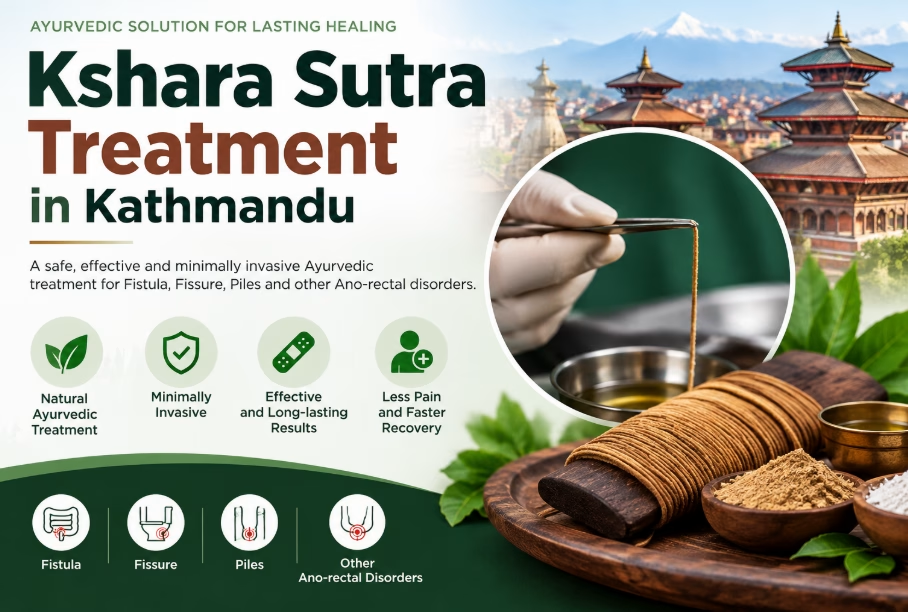
Kshara Sutra is an Ayurvedic para-surgical treatment in which a specially prepared medicated thread is used for selected anorectal conditions, particularly anal fistula (fistula-in-ano). It may also be considered for selected hemorrhoids and certain sinus tracts after proper clinical assessment.
At Nepal Ayurveda, Kshara Sutra treatment in Kathmandu should begin with one essential question: Is Kshara Sutra the right treatment for this particular condition?
Not every anal fistula, pile, painful lump or anal discharge requires the same procedure. The location and complexity of a fistula, involvement of the anal sphincter, presence of an abscess, previous treatment, other medical conditions and the patient’s symptoms can all influence treatment selection.
For this reason, diagnosis and patient selection should come before the procedure.
Is Kshara Sutra Right for Your Condition?
Kshara Sutra may be considered when examination confirms an anorectal condition for which this technique is clinically appropriate.
It is particularly associated with treatment of fistula-in-ano, traditionally described as Bhagandara in Ayurveda. It may also have a role in selected hemorrhoids and pilonidal sinus cases.
However, a draining opening near the anus, bleeding during stool or a painful anal lump does not automatically mean Kshara Sutra is required.
The first step is to establish:
| Clinical question | Why it matters |
|---|---|
| Is the problem actually an anal fistula? | Fissures, abscesses, hemorrhoids and other conditions may cause overlapping symptoms |
| Is an abscess present? | Acute abscesses may require prompt drainage |
| Is the fistula simple or complex? | Anatomy affects treatment selection and risk |
| How much sphincter muscle is involved? | Preserving continence is an important treatment goal |
| Has the fistula been treated before? | Recurrent disease may need additional assessment |
| Are there multiple or branching tracts? | More complex anatomy may change the treatment plan |
| Is Crohn’s disease or another condition involved? | Some fistulas require combined medical and surgical management |
Modern colorectal guidance similarly emphasizes that there is no single procedure appropriate for every fistula. Treatment should account for the cause and anatomy of the tract, symptoms, comorbidities and the effect of treatment on anal sphincter function.
For a conventional colorectal perspective, see the ASCRS clinical practice guideline for anal fistula management.
What Is Kshara Sutra Treatment?
Kshara Sutra is a classical Ayurvedic para-surgical technique using a medicated thread.
Traditional standardized preparations commonly involve coatings derived from materials such as Snuhi, Apamarga Kshara and Haridra. The thread is placed through or around selected diseased tissue so that it remains in contact with the treatment area.
In a fistula, the thread acts in a seton-like manner within the fistulous tract. It is typically changed periodically while the tract is gradually treated and allowed to heal.
The technique belongs to Shalya Tantra, the Ayurvedic discipline concerned with surgical and para-surgical management.
Kshara Sutra is not a home treatment. Correct identification of the tract, sterile technique, follow-up and management of complications require appropriately trained clinical care.
What Conditions May Be Treated With Kshara Sutra?
Anal fistula or fistula-in-ano
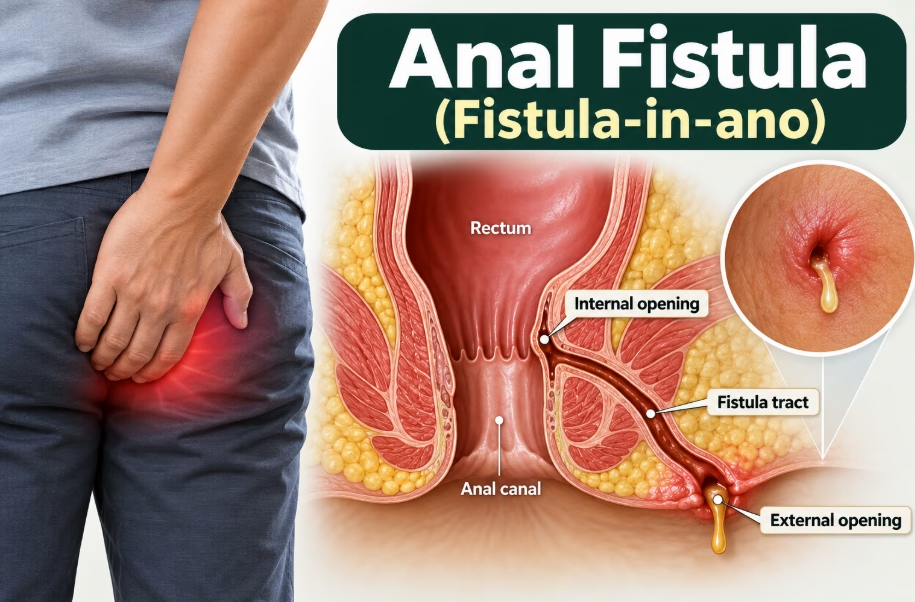
Anal fistula is the condition most strongly associated with Kshara Sutra.
A fistula is an abnormal tract connecting the anal canal or rectum with an opening in the skin near the anus. Patients may experience recurrent swelling, discharge of pus or fluid, irritation, discomfort and episodes in which an abscess appears to settle and then returns.
In Ayurveda, fistula-in-ano is commonly discussed as Bhagandara.
The important issue is not merely whether a tract exists, but where it travels in relation to the anal sphincter muscles.
A low, straightforward tract and a recurrent branching fistula are different clinical problems and may require different management.
Piles or hemorrhoids
Kshara Sutra ligation may be considered for selected hemorrhoidal disease where ligation of the pile mass is clinically appropriate.
It is not automatically the first treatment for every person with piles. Many hemorrhoid patients can initially be managed through better bowel habits, fiber intake and other conservative measures, while selected internal hemorrhoids can also be treated with established office procedures.
Patients primarily concerned about hemorrhoids can review our dedicated Ayurvedic piles treatment in Kathmandu service.
Pilonidal sinus
Kshara Sutra may also be used in selected pilonidal sinus cases.
Because pilonidal disease can vary considerably in extent, infection and recurrence, suitability should be determined after examination rather than from symptoms alone.
What Are the Symptoms of an Anal Fistula?
A fistula may develop following an anorectal abscess and can produce repeated cycles of swelling and drainage.
Symptoms that may warrant assessment include recurrent pus or fluid discharge near the anus, a small persistent opening in the perianal skin, recurrent swelling in the same location, pain that increases before drainage occurs, irritation around a draining opening and a history of previous perianal abscess.
These symptoms are not specific enough to diagnose a fistula by themselves.
A painful swelling associated with fever, rapidly worsening pain or systemic illness may indicate an acute abscess requiring prompt medical attention. Current colorectal guidance recommends prompt incision and drainage for acute anorectal abscess rather than delaying appropriate acute treatment.
How Is Anal Fistula Assessed Before Kshara Sutra?
A good Kshara Sutra treatment plan should begin with diagnosis rather than immediately scheduling the procedure.
1. Medical history
The clinician may ask about pain, drainage, swelling, bleeding, previous abscesses, previous fistula procedures, bowel habits, continence, inflammatory bowel disease and other relevant medical conditions.
2. Local examination
The area around the anus is examined for an external opening, discharge, swelling, scars from previous procedures and other anorectal conditions.
A digital rectal examination or anoscopy may be appropriate depending on the symptoms and clinical situation.
3. Assessment of the fistula tract
The clinician needs to understand the likely relationship between the tract and the anal sphincter.
This matters because preserving sphincter function and continence is a major goal in fistula treatment.
4. Imaging when necessary
Not every anal fistula requires an MRI.
However, imaging may be appropriate for selected patients with recurrent or complex fistulas, occult abscesses, immunosuppression or suspected Crohn’s-related disease. The ASCRS guideline specifically recommends considering imaging in such situations.
MRI can be particularly useful when clinicians need to identify branching tracts, secondary extensions or hidden abscesses in complex disease.
What Happens During Kshara Sutra Treatment for Fistula?
The exact technique can vary according to the fistula and clinical plan, but the classical process generally involves identification of the fistula tract, passage of a probe through the tract, placement of the medicated Kshara Sutra and securing the thread so that it remains in contact with the tract.
Anesthesia or pain-control measures are selected according to the planned procedure and individual clinical requirements.
After placement, the medicated thread is usually changed periodically. Weekly changes have been used in published Kshara Sutra protocols and are also described in Nepal-based clinical work.
During treatment, the thread provides ongoing contact with the tract while allowing drainage and gradual treatment of the involved tissue.
How frequently is the Kshara Sutra changed?
Many traditional protocols use approximately weekly thread changes, but this should not be turned into a fixed promise.
The schedule depends on the technique used, fistula anatomy, clinician assessment, local tissue response and healing progress.
How long does Kshara Sutra treatment take?
There is no responsible universal answer such as “four weeks” or “six weeks.”
Treatment duration can vary with tract length, fistula complexity, branching, previous operations, the type of Kshara Sutra used, individual healing and whether additional procedures are required.
A randomized comparison between Kshara Sutra and fistulotomy found that Kshara Sutra patients took longer on average to heal, although they had substantially fewer days away from routine work in that study.
An exact expected timeline should therefore be discussed after the fistula has been assessed.
What Should You Expect After the Procedure?
Follow-up is an important part of Kshara Sutra therapy.
Depending on the condition and technique, aftercare may involve periodic examination, thread replacement, local hygiene, wound or drainage care, bowel-habit management and monitoring for infection or other complications.
Some discomfort, burning or discharge can occur during treatment. The experience varies between patients and techniques, so Kshara Sutra should not be advertised as universally painless.
A 2025 retrospective study evaluating a modified minimally invasive Kshara Sutra technique in trans-sphincteric fistulas reported encouraging outcomes, but it studied a specific modified technique at a single centre and should not be used to predict the result for every patient.
What Are the Potential Advantages and Limitations of Kshara Sutra?
Patients deserve to understand both.
| Potential consideration | What it means |
|---|---|
| Gradual treatment | Treatment progresses through repeated follow-up rather than necessarily one large open wound |
| Continued drainage | The thread can help maintain a pathway for drainage during treatment |
| Outpatient follow-up may be possible | Some protocols are managed with repeated scheduled visits |
| Routine activity | Some research has reported fewer days away from work than open fistulotomy |
| Repeated visits required | Thread changes and follow-up can continue for weeks |
| Discomfort can occur | Pain, burning, irritation and discharge may occur |
| Healing can take time | Treatment may take longer than some surgical alternatives |
| Recurrence remains possible | No fistula treatment has a guaranteed zero-recurrence outcome |
| Not suitable for every fistula | Complex anatomy or associated disease can require a different or combined approach |
This balanced view is important because the published evidence does not support promising permanent cure, zero recurrence or guaranteed avoidance of surgery.
What Does Research Say About Kshara Sutra?
Kshara Sutra has been studied clinically, but the evidence varies considerably in design, size and quality.
A prospective study of 50 patients with fistula-in-ano reported relatively low recurrence after Kshara Sutra therapy, but it was an uncontrolled open study, which limits how confidently the findings can be generalized.
A randomized study of 50 patients comparing Kshara Sutra with open fistulotomy found longer healing time with Kshara Sutra but fewer days away from routine work.
Other evidence is less favorable. A prospective observational comparison of complex fistula treatments reported higher recurrence at longer follow-up in its Kshara Sutra group than in its LIFT and fistulectomy groups.
This is why Nepal Ayurveda should not present Kshara Sutra as universally superior to fistulotomy, LIFT, setons or other established procedures.
Patients who want to review the comparative research can see the published study comparing Kshara Sutra and open fistulotomy.
Nepal-based Kshara Sutra clinical work
Kshara Sutra has also been documented in clinical work from Nepal.
A published fistula-in-ano case report co-authored by Dr. Bijendra Shah described a patient treated with Kshara Sutra prepared at Nepal Ayurveda Trust & Research Centre and managed with periodic thread changes. Because this was a single case report, it should be viewed as documentation of clinical practice not proof of a universal outcome.
You can review the published Nepal Kshara Sutra fistula case report.
Kshara Sutra vs Other Anal Fistula Treatments
The best treatment for anal fistula depends heavily on fistula anatomy.
| Treatment | Basic approach | Important consideration |
|---|---|---|
| Kshara Sutra | Medicated seton-like thread placed in the tract | Requires repeated follow-up and appropriate selection |
| Fistulotomy | Fistula tract is laid open to heal | Well-established option for appropriately selected simple, low fistulas |
| Draining seton | Maintains drainage through the tract | Often forms part of staged management, particularly in complex disease |
| Cutting seton | Gradually divides involved tissue | Used selectively because sphincter function must be considered |
| LIFT | Treats the tract in the intersphincteric plane | Sphincter-preserving approach for selected fistulas |
| Advancement flap | Internal opening is covered with a tissue flap | Used in selected fistulas where sphincter division is undesirable |
ASCRS considers lay-open fistulotomy an established treatment for appropriately selected simple fistulas with normal sphincter function and reports high resolution rates in suitable patients. It also recognizes LIFT, advancement flaps, setons and other approaches for different fistula situations.
This does not mean one technique is always better than another.
It means the fistula should be mapped first and the procedure chosen second.
When Might Kshara Sutra Not Be the First Step?
Kshara Sutra should not replace urgent or more appropriate treatment simply because a patient prefers an Ayurvedic procedure.
Examples that require particular care include an acute anorectal abscess requiring drainage, suspected Crohn’s disease, complex or recurrent fistulas requiring further imaging, significant systemic illness and situations in which the diagnosis has not yet been established.
Previous treatment failure also deserves careful reassessment rather than automatically repeating the same procedure.
Kshara Sutra for Piles: Is It the Same Procedure?
No.
Kshara Sutra for a fistula tract and Kshara Sutra ligation of selected hemorrhoidal tissue are different applications of the same broader para-surgical concept.
For hemorrhoids, the important questions include whether the piles are internal, external or mixed; the amount of prolapse; bleeding; pain; thrombosis; grade of internal disease and response to conservative treatment.
Not every person with hemorrhoids requires Kshara Sutra.
For a fuller treatment decision guide, see Ayurvedic piles treatment in Kathmandu.
Why Choose Nepal Ayurveda for Kshara Sutra Assessment in Kathmandu?
A Kshara Sutra service should be judged by more than the availability of medicated thread.
The quality of assessment, understanding of anorectal anatomy, appropriate patient selection, ability to recognize cases requiring referral, sterile procedural care and structured follow-up all matter.
Nepal Ayurveda provides Ayurvedic hospital and consultation services in Kathmandu, with Kshara Sutra included among its Shalya-oriented treatment services. The Nepal Ayurveda hospital services include Ayurvedic doctors with surgical training.
Relevant Shalya Tantra expertise
Dr. Bijendra Shah is identified by Tribhuvan University’s Ayurveda Campus as a BAMS, MS (Shalya Tantra) practitioner with an anorectal focus and involvement in the Department of Shalya Tantra.
His academic work also includes Kshara Sutra-related publications involving fistula and anorectal treatment.
For independent professional context, see the Tribhuvan University Ayurveda Campus profile of Dr. Bijendra Shah.
What Happens at Your First Consultation?
Your first consultation should determine whether the symptoms actually represent fistula, piles, fissure, abscess, pilonidal disease or another anorectal condition.
The clinician can then assess whether Kshara Sutra is appropriate, whether additional investigation is needed and what reasonable alternatives exist.
Patients should bring previous operation records, MRI or ultrasound reports, prescription details and information about current medications when available.
You can arrange an Ayurvedic doctor consultation in Kathmandu before deciding on a procedure.
Questions to Ask Before Starting Kshara Sutra
Before consenting to treatment, ask what your exact diagnosis is, whether the fistula appears simple or complex, whether imaging is necessary, how the tract relates to the sphincter muscles, why Kshara Sutra is being recommended instead of another approach, how often follow-up will be required, what discomfort or complications are possible, what signs require urgent medical review, and what will happen if the tract does not heal as expected.
A provider should be able to discuss these points without promising a guaranteed cure.
When Should You Seek Urgent Medical Attention?
Do not wait for a routine Kshara Sutra appointment if you have severe or rapidly worsening anal pain, significant swelling accompanied by fever or systemic illness, heavy bleeding, fainting or another acute medical problem.
A suspected acute anorectal abscess requires prompt clinical evaluation.
Frequently Asked Questions About Kshara Sutra Treatment
Is Kshara Sutra treatment painful?
Some discomfort, burning or pain can occur, particularly around the procedure and thread changes. The severity varies by technique, fistula anatomy and individual response. It should therefore not be promoted as completely painless.
Is Kshara Sutra better than fistula surgery?
Not for every patient. Different treatments have different benefits and limitations. Simple low fistulas may respond very well to fistulotomy, while complex disease may require sphincter-preserving or staged approaches. Kshara Sutra may be considered for selected patients after assessment.
Does Kshara Sutra permanently cure fistula?
No responsible provider should guarantee permanent cure. Published studies report varying results, and recurrence is possible after Kshara Sutra as well as other fistula procedures. Anatomy, secondary tracts, Crohn’s disease, previous treatment and technique can affect outcomes.
How many Kshara Sutra sittings are required?
There is no fixed number appropriate for every patient. The treatment period can vary according to tract length, fistula complexity, healing and the particular technique used.
Is the thread changed every week?
Weekly replacement is commonly described in traditional and published Kshara Sutra protocols, but the treating clinician should determine the actual schedule for each patient.
Can I work during Kshara Sutra treatment?
Some people may continue or resume routine activity during staged treatment, depending on symptoms and the nature of their work. One randomized comparison reported fewer days away from work with Kshara Sutra than fistulotomy, although Kshara Sutra took longer to heal overall. Individual recovery can differ.
Is MRI necessary before Kshara Sutra treatment?
Not for every fistula. Imaging is more commonly considered when the disease is recurrent, complex, difficult to define, associated with an occult abscess, immunosuppression or Crohn’s disease.
Is Kshara Sutra available for piles?
It may be considered for selected hemorrhoids after examination. However, many piles cases do not require this procedure. The treatment decision depends on whether disease is internal, external or mixed, prolapse, symptoms and severity.
Where can I get Kshara Sutra treatment in Kathmandu?
Nepal Ayurveda provides Kshara Sutra and related Ayurvedic anorectal care in Kathmandu. Current contact information includes Kathmandu locations at Kuleshwar Road and Thamel. Confirm your consultation and treatment location when booking.
Book a Kshara Sutra Assessment in Kathmandu
If you have recurrent anal discharge, a previously diagnosed fistula, repeated perianal swelling, persistent piles symptoms or have been advised to consider an anorectal procedure, the next step is a proper assessment.
The purpose of the consultation is not to put every patient through Kshara Sutra. It is to determine what the condition is, how complex it is, and which treatment approach is most appropriate.
Book an Ayurvedic doctor consultation
For location and appointment information, contact Nepal Ayurveda in Kathmandu.